
There was a time when a vacant patch of ground was enough to keep an entire group of children busy until sunset. A few sticks, some chalk, a handful of marbles, or an old handkerchief could turn an ordinary afternoon into a fiercely competitive sporting event.
In Bengal, childhood had its own collection of games. Some demanded speed. Others required balance, cleverness, or the ability to fool your friends. And a few involved so much shouting that the entire neighborhood knew who was winning.
Many of these traditional Bengali games were played in village courtyards, school playgrounds, narrow lanes, and open fields. Some were common across West Bengal and Bangladesh, while others had distinctive local variations.
Smartphones and changing lifestyles have reduced the space these games once occupied. But the games themselves are worth remembering. Here are ten that shaped the childhoods of generations of Bengali children.
1. Danguli: A Game of Two Sticks and Sharp Eyes
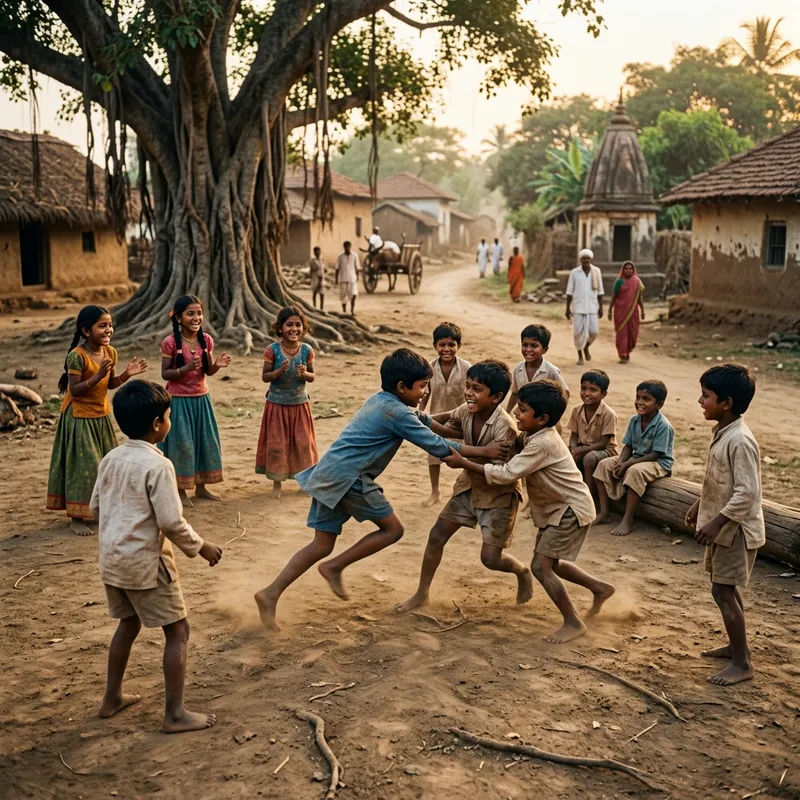
Danguli (ডাংগুলি) was one of the most recognizable outdoor games in rural Bengal. It required just two wooden sticks: a short piece called the guli and a longer stick called the dang.
The short stick was placed on the ground, often across a small groove. The player used the longer stick to flick it into the air and strike it as far as possible. Other players tried to catch it or prevent the striker from scoring.
The game demanded timing, hand-eye coordination, and considerable skill. It also required enough open space to avoid hitting someone accidentally. A poorly directed guli could become an unexpected projectile, so safety was always important.
Danguli had similarities to games such as gilli-danda played in other parts of India, although local rules varied.
2. Kanamachi: Catching Friends Without Seeing Them
“Kanamachi bho bho, jake pabi take chho!”
Few Bengali childhood rhymes are as closely associated with a game as this one.
Kanamachi (কানামাছি), literally meaning blind fly, is the Bengali version of blind man’s buff. One player has their eyes covered with a cloth and becomes the kanamachi.
The others move around, calling out or making sounds to confuse the blindfolded player. The challenge is to catch someone by touch. Depending on the local rules, the captured player may have to be identified before becoming the next kanamachi.
It sounds simple, but the excitement increases when everyone starts moving in different directions. The blindfolded player often ends up chasing absolutely nobody.
3. Gollachut: The Great Escape
Gollachut (গোল্লাছুট) was a team game built around speed, coordination, and clever escapes.
A stick was planted in the ground to mark a central point. Players on one team held hands and moved around this point, while the opposing team tried to catch them as they broke away and ran towards a designated boundary.
The objective was to escape without being touched by an opponent.
The game required players to watch their opponents carefully and choose the right moment to run. A premature escape could end in an easy catch. A well-timed dash could turn the entire game around.
The rules and arrangements differed between localities, but the combination of running, teamwork, and quick decisions made Gollachut a memorable favourite.
4. Dariabandha: Outsmarting the Opponent
Dariabandha (দাঁড়িয়াবান্ধা) turned an ordinary piece of ground into a competitive playing field.
Players drew a rectangular grid divided into smaller sections. One team guarded the lines, while the opposing team attempted to cross the sections without being touched.
The attackers had to judge the movements of the defenders and find openings. A moment of hesitation could mean getting caught.
Dariabandha was not simply about running fast. It required patience, timing, and the ability to anticipate an opponent’s next move.
The game was particularly familiar in rural Bengal. Its name and rules varied across regions, and similar versions were played in neighboring areas of the subcontinent.
5. Ha-Du-Du: The Breathless Battle
Ha-du-du (হা-ডু-ডু) is closely associated with Bengal’s sporting traditions. It is also the traditional form from which modern kabaddi developed.
Two teams face each other across a marked playing area. A player from one side enters the opponent’s half and attempts to touch one or more defenders before returning safely.
In the traditional form, the raider repeatedly chants “ha-du-du” while holding their breath. The opposing players try to stop the raider from returning.
Unlike some other childhood games, Ha-du-du demanded considerable physical strength and stamina. It also required teamwork. Defenders had to coordinate their movements rather than chase the raider individually.
The game has a particularly strong connection with rural Bengal and Bangladesh. Modern kabaddi now follows organized rules and is played competitively at national and international levels.
6. Lukochuri: The Original Hide-and-Seek
Lukochuri (লুকোচুরি) needed no equipment, no playing field, and almost no preparation.
One player closed their eyes and counted while the others scattered to find hiding places. Once the counting ended, the search began.
A tree, staircase, courtyard, abandoned corner or the space behind a parked vehicle could become a hiding place.
The excitement was in finding a spot that was clever enough to avoid detection but not so clever that nobody could find you.
Lukochuri was popular because children could play it almost anywhere. A small group of friends was enough, and the rules could be adjusted depending on the available space.
It remains one of the easiest traditional games to introduce to children today.
7. Ekka-Dokka: The Art of Balancing on One Leg
Ekka-Dokka (এক্কা-দোক্কা), also known in many places as hopscotch, was a familiar sight in schoolyards and neighborhood courtyards.
Players drew numbered boxes on the ground with chalk or a piece of brick. A small stone or tile was thrown into a designated box.
The player then hopped through the boxes, usually on one leg, avoiding the marked square and maintaining balance.
The challenge was to complete the course without stepping on a line or losing balance. As the game progressed, the difficulty increased.
It was especially popular because it required almost nothing beyond a flat surface, a small stone, and a little space.
8. Pittu: Seven Stones and Plenty of Running
Pittu (পিট্টু), also known in different regions by names such as seven stones or Lagori, was a lively team game.
A small pile of flat stones was arranged one above another. One team threw a ball to knock the pile down. The opposing team then tried to hit the players with the ball while they attempted to rebuild the pile.
The throwing team had to defend its players and prevent the opposing side from completing the task.
Pittu combined throwing accuracy, quick movement, and teamwork. It was also the sort of game in which a temporary alliance between two friends could disappear the moment one of them got hit.
Local rules differed, including the number of stones and the way players could be eliminated.
9. Rumal Churi: The Handkerchief Chase
Rumal Churi (রুমাল চুরি) was a simple group game that could become surprisingly competitive.
Players sat or stood in a circle. One participant carried a handkerchief and moved around the outside while the others looked ahead.
The handkerchief was secretly dropped behind someone. That player had to notice it, pick it up, and chase the person who had dropped it before they could complete a round and occupy the empty spot.
If the player failed to notice the handkerchief in time, they could become the next person carrying it.
The game relied on observation and quick reactions. It was particularly suitable for groups and required very little preparation.
10. Lattu: The Spinning Top
Lattu (লাট্টু) was a small toy that demanded more skill than its appearance suggested.
The traditional wooden spinning top was wound with a string. A quick throw released it onto the ground, where it spun on its pointed base.
The real challenge was controlling the top. Experienced players could make it spin steadily, lift it into their hands, or perform other tricks.
Children often competed to see whose lattu could spin the longest. Some even tried to knock another player’s spinning top off balance.
A simple wooden toy could provide hours of entertainment. It also rewarded practice, patience and a steady hand.
Are These Games Completely Forgotten?
Not quite. Some are still played in schools, village communities, cultural programmes and local sporting events. Ha-du-du, in particular, has evolved into organized kabaddi.
However, many other games have become less visible in everyday childhood.
There are practical reasons. Urban spaces have changed. Open grounds are harder to find in many neighbourhoods. School schedules, traffic, safety concerns and digital entertainment have also changed how children spend their free time.
It would be unfair to blame smartphones alone. The disappearance of accessible play spaces is an important part of the story.
These games also carried something that is difficult to reproduce through a screen. Children made their own rules, settled arguments, formed teams and learned to deal with winning and losing. Older children often taught younger ones how to play.
The best way to keep these games alive is not necessarily to organize elaborate preservation programmes. A school playground, a community gathering or a family afternoon can be enough to introduce them to another generation.
And if you remember playing any of these games, you probably remember something else too: the arguments over whether someone had been caught, whether a throw was valid and whether the game was really over.
Those arguments were part of the fun.