


Bishnupur Terracotta Temples: History, Art and Architecture
In Bishnupur, some of Bengal’s most remarkable historical stories are told without a single written sentence. They are carved into
Have you ever caught the earthy, comforting scent of rain hitting old terracotta tiles and felt an unexpected tug at your heart?
That single breath of nostalgia can transport you straight across thousands of miles. It does not matter if you are sitting in a high-rise office in Bengaluru, sipping evening tea in London, or walking down a bustling lane in North Kolkata.
When you feel that deep, quiet pull, you know you are searching for something more. You are looking for a story, a connection, a piece of home.
Most of us grew up knowing the standard postcards of Bengal. We know the grandeur of the Victoria Memorial, the iconic roar of Howrah Bridge, and the historic charm of College Street bookshops. But if you pause and ask yourself what else is there beyond what you see on the surface, an incredible world of hidden stories, forgotten architectural marvels, and living traditions opens up.
Welcome to the heart of Bengal’s heritage. Here, we look past the usual tourist guides to explore the real, breathing history of Bengal.
When people talk about heritage, they often picture dusty museum display cases or dry textbook dates. But for the curious Bangalee, heritage is never static. It is a living, glowing ember that warms our daily lives.
It is woven into the very fabric of who we are. You feel it in the rhythmic, thumping beat of the dhak that signals the arrival of autumn. You see it in the intricate, geometric handloom weave of an old Baluchari saree passed down from your grandmother. You taste it in the quiet intellectual comfort of an afternoon adda over a hot cup of tea.
Whether you grew up surrounded by these traditions or are an outsider simply enchanted by the magic of eastern India, Bengal’s history offers a mirror to your own curiosity. It invites you to explore Historical Places that shaped revolutions, art, and everyday life.

Source: Wikimedia Commons
If you venture just a little bit off the beaten tourist path, Bengal’s landscape transforms completely.
Long before modern concrete skylines took over, master builders and local rulers created architectural wonders using materials born straight from the soil. Because stone was rare in the deltaic plains, local artisan guilds turned to burnt clay and terracotta.
Head over to Bankura district, and you will find the breathtaking terracotta temples of Bishnupur, built by the Malla kings centuries ago. According to historical documentation preserved by UNESCO, these structures are living galleries where master carvers etched entire epics from the Mahabharata and Ramayana directly onto clay tiles. Walking past these red-brick walls feels like reading an open-air storybook carved by hand.
A short drive along the Hooghly River takes you through a fascinating historical mini-Europe. Chinsurah still preserves old Dutch colonial footprints. Chandan Nagar greets you with charming French boulevards and whitewashed villas. Serampore holds vital milestones in early South Asian printing history.
If you love exploring how these visual landmarks tell our story, you will enjoy diving into our deep dive on Architecture.
To truly appreciate the depth of Bengali heritage, it helps to look at how different cultural threads weave together.
In architecture, indigenous thatched-roof styles blended with European neoclassical touches and clay carvings. In handlooms and crafts, Kantha embroidery and Dokra metal craft carry domestic stories and village folklore across generations. In performing arts, Baul minstrel music, Jatra theatre, and Chhau dance bring emotional resonance and folk mysticism to life.
Behind all of this lies a deep societal reverence for the written word. From ancient manuscripts to modern independent poetry, print culture has always been a pillar of the Bengali mind.
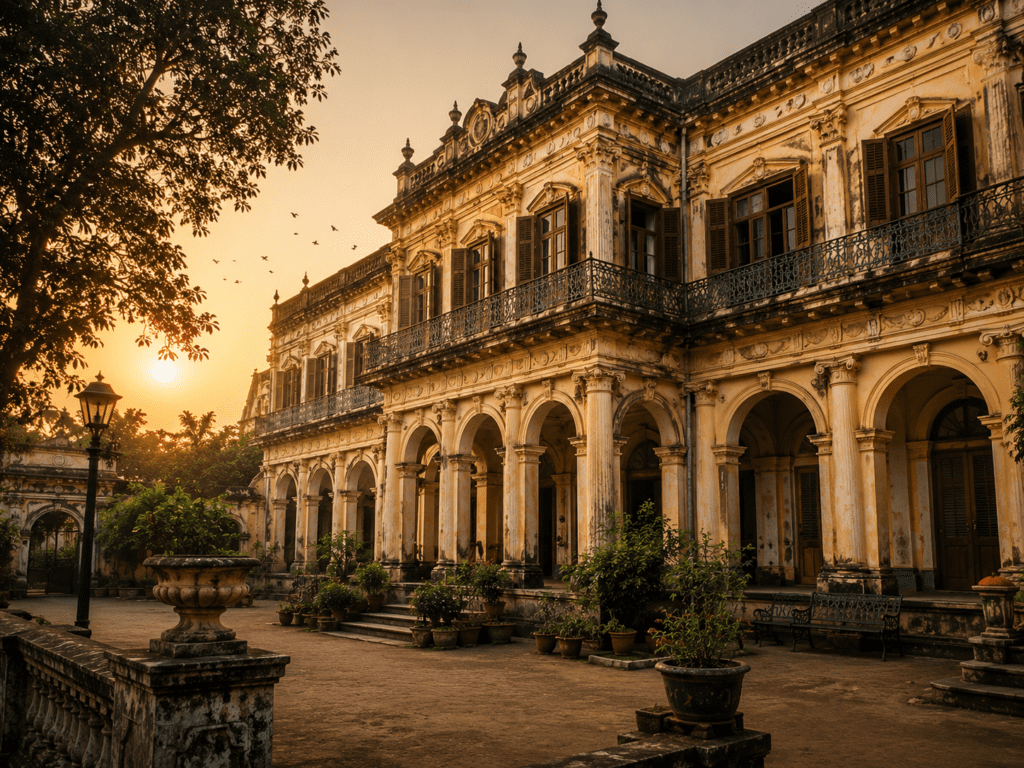
Across rural Bengal and the quiet lanes of old neighborhoods, grand royal mansions stand as silent witnesses to a bygone era.
These sprawling estates feature sweeping arches, cast-iron spiral staircases, and massive central courtyards. They were once the epicenters of elite patronage, where classical music floated through evening salons and literary giants gathered to debate social reform during the Bengal Renaissance.

Source: Wikimedia Commons
Today, many of these grand estates are crumbling away, while others are lovingly restored into heritage stays. Exploring them gives you a tangible sense of how the aristocracy lived, celebrated, and patronized the arts.
Why Heritage Matters in Our Modern Lives
Why should a busy professional, a young student, or someone living thousands of miles away care about old temples and royal mansions?
Because heritage offers a firm anchor in a fast-changing world.
In an era of endless scrolling and digital noise, revisiting our roots grounds us. It gives us a sense of true belonging. Finding a piece of your ancestral story—whether it is learning about a forgotten folk art form, discovering a secret family recipe, or exploring a centuries-old lane—helps complete the puzzle of who you are.
We believe that history shouldn’t feel like a boring classroom lecture. It should feel like a fascinating story told by an old friend over an afternoon cup of tea.
We invite you to slow down for a moment, take a sip of your tea, and wander through our stories.
Whether you are a proud Bengali looking to rediscover your roots, or a curious traveler eager to learn about one of India’s most culturally vibrant regions, there is always something new to uncover here.
Take a look around, explore our curated guides, and let Bengal feel like home.
In Bishnupur, some of Bengal’s most remarkable historical stories are told without a single written sentence. They are carved into

In the southern part of Kolkata, surrounded by busy streets, shops selling flowers and offerings, and the constant movement of