
In Bishnupur, some of Bengal’s most remarkable historical stories are told without a single written sentence. They are carved into the walls of temples, shaped in burnt clay, and preserved through centuries of changing rulers and religious traditions.
A warrior riding into battle, Krishna playing his flute, a royal procession, or a scene from the Ramayana: these are not separate decorations added to an otherwise ordinary building. They are part of the architecture itself.
The terracotta temples of Bishnupur, in Bankura district, represent an important chapter in Bengal’s artistic and architectural history. Built largely under the patronage of the Malla rulers, these structures demonstrate how local building traditions, religious devotion, and skilled craftsmanship came together to create something distinctive.
Their walls also offer an unusual glimpse into the world of Malla Bengal. Look closely, and you will find that they tell stories about much more than gods and goddesses.
How Bishnupur Became the Centre of Malla Bengal
Bishnupur was the historic capital of the Malla kingdom, also known as Mallabhum. The Malla dynasty ruled a substantial part of present-day Bankura and surrounding regions.
According to the historical account presented by the Bankura district administration, Adi Malla established the dynasty, while his descendant Jagat Malla shifted the kingdom’s capital to Bishnupur.
The kingdom reached an important period of cultural development under rulers such as Bir Hambir, Raghunath Singh, and their successors.
Royal patronage encouraged temple construction, music, painting, pottery and weaving. Bishnupur gradually became an important centre of artistic activity in Bengal.
The temples we admire today largely belong to the seventeenth and eighteenth centuries, although the town’s religious history is considerably older.
An interesting feature of this architectural development was the use of locally available materials. Stone was not readily available in the region in the quantities required for large-scale construction. Brick and burnt clay therefore became important building materials.
Local craftsmen turned this practical requirement into an extraordinary artistic opportunity.
Why Terracotta Became So Important in Bishnupur

Terracotta is clay that has been shaped and fired to make it hard. The word comes from Italian and literally means baked earth.
In Bishnupur, craftsmen used fired clay bricks and carefully prepared terracotta plaques to construct and decorate temples.
The process required considerable skill. Artisans shaped clay into figures, decorative panels, and ornamental designs before firing them. These elements were then incorporated into the temple’s brick structure.
The result was a form of architectural decoration that could accommodate remarkably detailed scenes.
Unlike paintings, which can fade or disappear, properly fired terracotta elements can survive for centuries. However, weathering, moisture, biological growth and neglect can damage them over time.
The craftsmanship is particularly impressive because the artists had to work within the physical limitations of clay. They created figures, clothing, jewelry, animals and elaborate scenes on relatively small surfaces.
The temples also reveal that Bengal’s architectural traditions did not develop in isolation. Curved cornices, pointed arches, cusped entrances and aspects of the decorative vocabulary show connections with earlier Islamic architecture in Bengal.
The result was not a straightforward imitation of another style. It was a distinctive architectural language shaped by local needs and artistic choices.
Three Temples That Show the Range of Bishnupur’s Architecture
The best way to understand Bishnupur’s temple architecture is to look at a few important structures. Each has a different design, and each offers something different to the visitor.
1. Rasmancha: A Temple Unlike Any Other
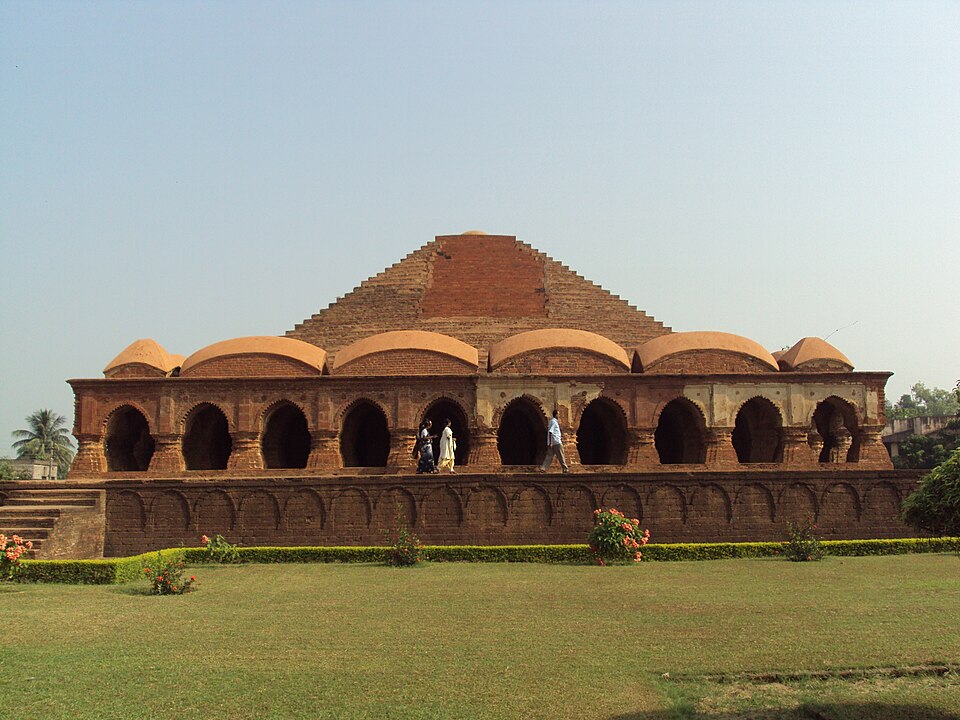
Built around 1600 CE by King Bir Hambir, the Rasmancha is among Bishnupur’s earliest surviving monumental brick structures.
Its design is unusual. A broad laterite platform supports a pyramidal superstructure surrounded by hut-shaped turrets. The structure also has three surrounding galleries with arches and pillars.
Rasmancha was not simply another shrine for everyday worship. Its principal purpose was connected with the Ras festival, when images of Krishna from different temples were brought together for public viewing.
This arrangement gave the building a special ceremonial role. Instead of visiting several individual temples, devotees could see the festival images gathered at one place.
The structure is a good example of how the Malla rulers and their architects adapted familiar local building forms to create something distinctive.
2. Shyam Rai Temple: Five Towers and Extraordinary Detail
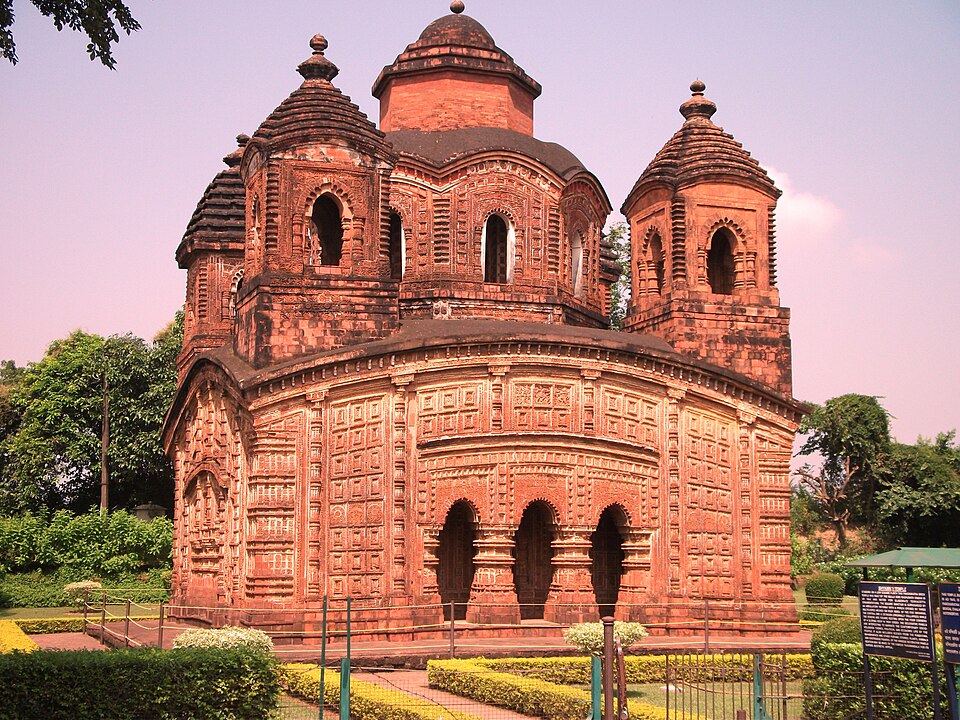
The Shyam Rai Temple was built in 1643 under King Raghunath Singh.
It is popularly known as the Pancha Ratna temple. Pancha means five, while ratna means jewel. The name refers to its five towers: one central tower and four smaller corner towers.
The temple is particularly important for its extensive terracotta decoration. Its walls, arches and other architectural surfaces contain an impressive collection of sculpted panels.
Scenes from Krishna’s life occupy an important place. There are depictions of Radha and Krishna, Krishna playing his flute, and episodes involving other figures from Hindu mythology.
One particularly interesting feature is the large Raschakra, which depicts Krishna’s divine dance with the gopis.
The decoration also extends beyond religious subjects. Hunting scenes, warriors and other aspects of historical life appear among the panels.
The temple shows how an architectural structure could become a carefully organised visual narrative.
3. Jor Bangla Temple: Two Village Huts in Brick
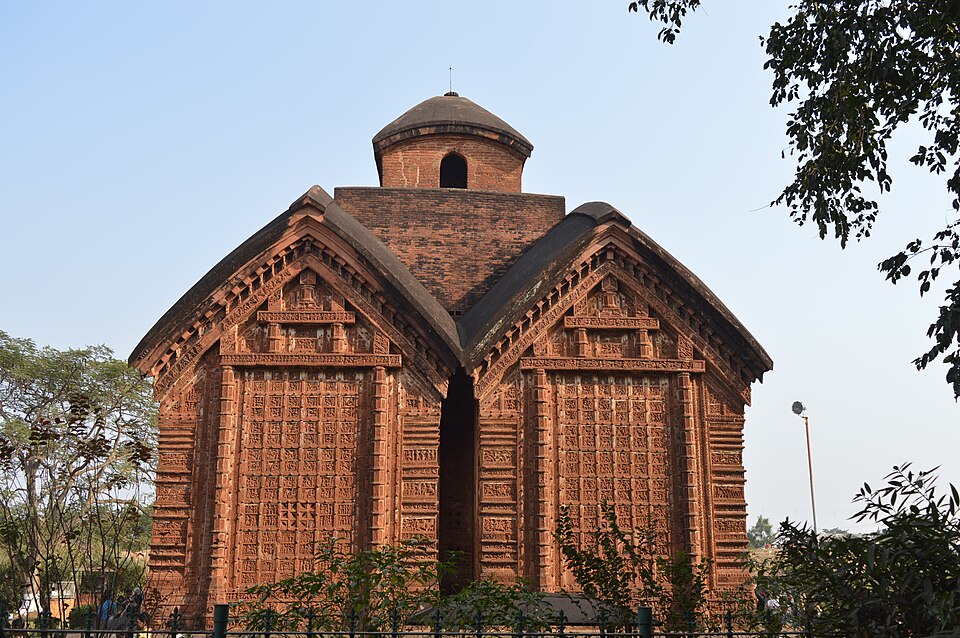
Built in 1655 under Raghunath Singh, the Jor Bangla Temple is one of the most recognisable structures in Bishnupur.
Its name describes its design. Jor means joined, while Bangla refers to Bengal-style houses.
The temple looks like two traditional Bengali huts joined together. One functions as the entrance porch and the other as the main shrine. Their curved roofs meet beneath a central tower.
This design draws inspiration from the traditional do-chala houses of rural Bengal. These houses have two sloping roof sections, often with gently curved edges.
The temple’s terracotta panels are equally remarkable.
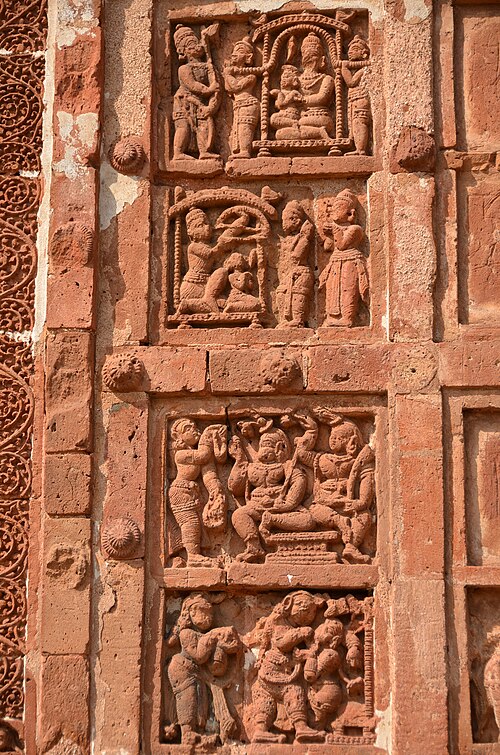
They portray episodes from the Ramayana and Mahabharata, scenes from Krishna’s childhood, and other mythological subjects. Some panels depict familiar stories such as the marriage of Rama and Sita and the confrontation between Lakshmana and Surpanakha.
The combination of a recognisably Bengali roof form and elaborate sculptural decoration makes Jor Bangla particularly interesting.
It is also a reminder that temple architecture does not always need to borrow its visual identity from distant traditions. Sometimes, the inspiration is right outside the architect’s window.
What Do the Terracotta Panels at Bishnupur Actually Depict?

The panels are among the most valuable historical features of Bishnupur’s temples. They provide information about religious beliefs, artistic traditions, and aspects of contemporary society.
Their subjects can broadly be understood in four groups.
1. Krishna’s life and Vaishnava traditions
Krishna is one of the most frequently represented figures. Scenes show him playing the flute, interacting with Radha and the gopis, and participating in episodes from Krishna’s life.
These themes reflect the influence of Gaudiya Vaishnavism, a devotional tradition associated with Chaitanya Mahaprabhu.
2. The Ramayana and Mahabharata
The great Indian epics provided artists with a large collection of stories and characters. Scenes involving Rama, Sita, Lakshmana, Ravana, Bhishma, and other figures appear across the temples.
3. Gods, goddesses, and mythological stories
The panels also include different deities, mythological battles, and episodes from the Puranas.
4. Everyday life and royal activities
Some of the most interesting panels move away from religious storytelling. Hunting, warfare, processions, animals, musicians, and royal activities appear in the decorative programme.
These scenes are particularly useful because they offer glimpses of the social and material world of the period.
They should not, however, be treated as photographic records. Artists selected, interpreted, and arranged subjects according to religious, artistic, and patronage-related preferences.
This is what makes the panels worth studying. They are simultaneously works of art, religious expressions, and historical sources.
The Architecture: A Distinctive Blend of Bengal’s Building Traditions
Bishnupur’s temples are not all built in the same style. Their designs reflect the creativity of local architects and the changing requirements of temple worship.
Three architectural terms are particularly useful when looking at them.
- Do-chala: A structure with two sloping roof sections, inspired by traditional Bengali huts.
- Eka-ratna: A temple with one tower or pinnacle above its main structure.
- Pancha-ratna: A temple with five towers, usually one central tower and four smaller corner towers.
Another important feature is the curved cornice. Its shape resembles the curved edges of traditional rural Bengali roofs, which were often made using bamboo and thatch.
There are also architectural elements associated with Bengal’s earlier Sultanate-period buildings, including cusped arches, faceted pillars, and vaulted interiors.
This combination makes Bishnupur particularly interesting from an architectural perspective. Its temples are distinctly Bengali, but their design also reflects centuries of interaction between different building traditions.
The People Behind the Art
The Malla rulers provided the patronage, but the temples would not exist in their present form without the work of the artisans.
These craftsmen understood how to turn ordinary clay into detailed architectural decoration. They worked with religious stories, local visual traditions, and the expectations of their patrons.
Interestingly, the terracotta tradition did not end with the historical temples.
Panchmura, a village in Bankura district, remains an important centre of terracotta craftsmanship. Its artisans are known for their clay horses and other decorative objects. Contemporary artisans have also produced panels inspired by Bishnupur’s temple designs.
The connection between the historic temples and present-day craftsmanship gives the region’s terracotta tradition a continuing identity.
It is important, however, to distinguish the original temple panels from modern reproductions. They belong to different historical contexts, even when they share visual influences.
Preserving Bishnupur’s Terracotta Heritage
The survival of these temples across several centuries is remarkable. But age alone does not guarantee their future.
Terracotta is durable, but it is not indestructible. Rainwater, moisture, vegetation, pollution, and inappropriate repair work can damage the carved surfaces. Even small losses can destroy important details in a narrative panel.
Conservation therefore requires more than repairing visible cracks. It involves understanding the original materials, construction techniques, and decorative arrangements.
Bishnupur’s heritage also extends beyond the temples themselves. Its traditional crafts, historic water bodies, music and weaving traditions form part of the same cultural landscape.
The town deserves to be understood as a living heritage centre rather than simply a collection of monuments for sightseeing.
Reading the Walls of Malla Bengal
Bishnupur’s terracotta temples offer something that is not always easy to find in historical architecture: a close connection between buildings and the lives, beliefs, and artistic imagination of the people who created them.
The Rasmancha tells us about public religious celebrations. Shyam Rai displays the extraordinary possibilities of terracotta sculpture. Jor Bangla demonstrates how the humble forms of Bengali village houses could inspire monumental architecture.
Together, they preserve a visual record of Malla Bengal that continues to reward careful observation.
The next time you see a photograph of a Bishnupur temple, look beyond its towers and curved roofs. Notice the smaller panels. Look at the animals, musicians, warriors, and scenes from everyday life.
Some of the most interesting stories are hiding in the smallest details.